Sunday, 29 November 2015

Death is like a dream


The Denial of Death. By Ernest Becker. 1973 The Free Press. 1975. 

This review was written on May 15th 2015

I found this book in my library recently. It had been lent to me some years ago by Lorcan Walshe but I had not returned it to him. As I am now in  my ninety fourth  year I thought it worth  reading as I find myself thinking about the prospect of death more frequently; but Becker’s book seemed  too complex and too impractical to face what is an inevitable and straightforward event. For example some of the comments by critics in the introduction to the book were as follows:-

 --A magnificent psychophilosophical synthesis of power and insight;
 -- A masterful articulation of the limitations of psychoanalysis;
 -- will be acknowledged as a major work;
  - -unfolding of a mind grasping of new possibilities and forming a new synthesis;
  -- One of the great new books of the 20th or other centuries;
  -- astonishing insights into the theories of Sigmund Freud, Otto Rank, Soren Kierkegaard, Carl Jung, Erich  Fromm and other giants; etc, etc.

The other five commentators write very much along such lines but I stopped my reading of the text on page 35 of the 315 pages as I reckoned that my own purpose in facing death and in preparing my mind for the event will not be served by any of the more theoretical and philosophical aspects of dying as provided by the author of this masterpiece. Nor in the final analysis was my concern about myself of any significance but rather a wider concern about the fate of family, friends, and humanity in general and the world we live in.  

I suppose it was about 2 years or so ago when I began to think regularly about death and its approach. My thoughts included a melange of uncertainty, curiosity and melancholy but not of fear. As time passed the sense of curiosity began to dominate my feelings rather than that of melancholy.  I have already noted my physical, mental, social and psychological changes which have taken place and which have been the principal features  of aging during the third stage of  life, although it is  difficult to say when this stage started, it was certainly later than the date of official retirement.  These changes I have described in some detail in my 4th edition of My Challenge to Ageing which was brought up to date on Kindle in 2014.

I have been fortunate that I have never suffered any serious illness during my lifetime apart from a few remediable injuries. There has been a slow and barely noticeable loss of physical strength in later years, now accelerating in the last year or two, and there has been a gradual and often erratic deterioration in other functional and physical aspects of my life. They include hearing and vision, dry eyes and dryness of the mouth at night, appetite reduction, sensitivity to cold and alcohol, erratic sleeping patterns, a reduction and ultimately cessation of sex, and a  tendency to cramps, particularly unpleasant in the hands after long standing use of books and now the iPad and Kindle.

Mood and other psychological and social changes are inevitable as one gradually loses touch with wider society and particularly as one’s contemporaries and old friends pass gradually from the scene.  However, despite the social and physical changes of ageing, isolation need not prevent us seeking access to the activities provided by family and others, and taking advantage of such means of communication as radio and television, not to mention the computer, the Ipad and the Kindle. I still maintain my regular walking programme although now reduced to about four times a week and perhaps for a distance of about one to two miles. I am careful to avoid accidents – the stairs, the footpaths, the house lighting and the loose rug.  I have no obvious reduction in my intellectual abilities in terms of speech and writing although my initiative to write a new blog has diminished during the last year or two.  It seemed such an easy task until recently. I am now more inclined to forget a name, particularly of a person, flower or tree which I am familiar with but which I cannot recall because of a sudden and unexpected confusion in an attempt to identify the word.

Of course, to return to the subject of one’s attitude to death, the limitations imposed by ageing, whether physical, situational, psychological, are factors in themselves which must influence one’s attitude.  One might clearly welcome death as a relief if life becomes more isolated and less tolerant and relevant in the minds of others of a different age and society.

Blogger and Editor 
Perhaps the greatest change in my life in the recent past has been caused by the loss of contemporary friends whose company and interests I shared and enjoyed so much.   I still share contact with my three generation family and friends but such contacts with the younger generations, added to limitations of hearing and comprehension, can be embarrassing compared to the interests which I enjoyed with my more intimate contemporaries. One is aware of the different interests of other generations and there are the problems of hearing during their more intensive conversations.    Naturally it is not surprising that their interests are different from mine.  My relationship with my wife, now 37 years in duration, has not changed although my more physical means of showing my feelings has reduced since my late 80s.  She is 23 years younger than me and happily her social life is consistent with such an age group and has not been changed by our age gap.   

I have followed a life-style which not only leads to longevity but which greatly reduces the length and severity of decrepitude which is still too common among our older community.  Appropriate adaptation to the normal changes of ageing is mandatory.  If we can remain active during the third stage of life and if we accept the inevitable changes which occur at this time; we will continue to have some influence in society despite hearing and sight changes, and loneliness and loss of friends and family. The elderly should be dealt with by education, adaptation and understanding. It is surprising how the occasional ‘phone call from family and close friends can maintain our touch with society.

Have I any regrets in recent years?  Yes, it was our inability to influence humanity about the major disaster which is facing our children and other living things as we are rapidly destroying the natural world on which we depend for our survival. In my short time of 93 years hundreds of animal and plant species have disappeared from the earth and continue to do so.  Because the changes are gradual we are not aware of them. Even more rapid changes are ignored. Witness the abrupt loss of the Passenger Pigeons in the United States (as per a previous blog) with little comment or concern by the public!  During my 93 years the human population has increased by more than three times and continues at a rate of 80 million a year. The drying up of water in rivers and lakes,  and changes in the oceans presage physical changes which may be incompatible with life as we know it now. Carbon changes too will make life intolerable.  The increase of carbon in the atmosphere during the last century is a substantial and glaring warning to us and it is evidently increasing at a semi-exponential rate. It will have a dire effect on living things sooner than we think. Our politicians are represented by an electorate which is deeply committed to wealth, social standing, personal wellbeing, power and comfort, and a disregard for our natural world.  We therefore cannot expect our politicians to lead us in our defence of Nature and the future of humanity. Who else can do so? They cannot deal with the symptoms of disaster let alone its causes – the declining morale and the poverty of some nations, our reaching for the sky in search of wealth, the overcrowding, the Mediterranean problem, the religious and internal political wars, and most of all the continued increase in the human population and the easy availability of the nuclear bomb when the problems of overcrowding and a decaying environment become intolerable. Hopefully the immediate forthcoming Paris conference will wake us up and our leaders too!

To return to my attitude to death, I have no sense of fear and I am comforted by my certainty that there can be no personal sequelae to follow. Death and its fear is an insubstantial illusion, like a dream. We do not even understand the world we are living in, its origins and limitations in terms of time and space. We will never understand these, and our invention of another world adds further to our ignorance and our confusion.  My only fear is for humanity and all our living species and the wonderful world we were provided with and which we may well destroy because of human arrogance, selfishness and ignorance.  My book (Survival and Humanity) appears next Spring and says it all!

Friday, 20 November 2015

Drumlins and other interesting things.

Robert Lloyd Praeger

Irish Landscape. R. Lloyd Praeger. Cultural Relations Committee of Ireland, Dublin, 1961. pp 41.

This review was written on March 18th 2011.

This is one of 14 booklets published by the Cultural Relations Committee of Ireland and written by distinguished authors. I bought it in March from Greene’s second-hand list for 9 Euro. These booklets deal with many aspects of Irish art and culture, past and present. Robert Lloyd Praeger was well known as a botanist and naturalist and for his many publications. His autobiography The Way that I Went, bought originally by my father, is a classic about the natural history of Ireland and has a special place in my library. He believed that our landscape is peculiar to Ireland because of our latitude, our position facing the Atlantic and dominated by wind, rain and an equable climate, and the very ancient limestone central plain so suitable for grassland and the rearing of cattle, and surrounded by the beauty of the mountain ranges.

Praeger was born in Belfast and his early research was on the geology of the north-east of Ireland and in excavations there. The north-east is unique in this country in geological terms because its volcanic origin, unlike the rest of Ireland where the rocks are older and have a very different history. Just as the turn of the 19th and 20th  centuries marked the days of the Celtic Twilight, with its writers, poets and dramatists, so at the same time and as part of Ireland’s intellectual revival, the natural history of our country was greatly advanced and led by Robert Lloyd Praeger.

Grianán of Aileach
The booklet is designed as a travel guide with an introduction in the first 20 pages on the general aspect of the Irish landscape, including its countryside, its towns and villages, its roads, fields, characteristic high hedges and hedgerow trees; its bird life and wild life, including  alien species, such as the muskrat, and most remarkable,  the many  remains of  past  generations – Dun Aengus, Clonmacnoise, the round towers, the Grianán of Aileach and countless others still in a remarkable state of preservation. He describes the topography of the country with its central plain of limestone, often concealed by a thick blanket of bog, now sadly disappearing, and the numerous mountain ranges with their huge contribution to the panorama and scenic beauty of our country.  Nor does he forget to describe the natives of the countryside, their way of life, their occupations and their well established superstitions.

The second half of the book he goes from north to south to describe the physical, panoramic and particularly the geological features peculiar to different parts of the country. He starts with Donegal where he describes the unspoilt beauty of the area. What would he think to-day of the dreadful rural sprawl we saw when myself and Louise were last there in Rosapenna. He writes about the white washed cottages in the hollows, the donkeys, geese and dogs, and the abundance of wild flowers, all too evocative of my own days in Kerry in the 1930s. Donegal is the oldest part of Ireland geologically while the basaltic north east is the youngest part of the country.

Drumlin country in Co. Down
He moves from Donegal, perhaps with less detail, to the north-east, the mid-west, the mid-east, the south west and finally the south east parts of the country. He obviously was most familiar with the fascinating geology of the north east where he was born and where he developed his great interest in geology and natural history. The Drumlin country above the Dublin-Galway line is evident in the tortuous roads of  Co. Down and also the numerous small islands in Clew Bay in Mayo. He writes about Lough Neagh, the largest and least known of our many lakes with the pollen, and its unusual waters.  Other outstanding places of interest in Ireland are alluded to elsewhere and the black and white photographs are an additional feature. I would consider that Praeger gives a good insight into the Ireland of the mid-20th century. 

Friday, 13 November 2015

John Millington Synge


John Millington Synge – a Biography. By David M. Kiely. Gill and Macmillan, 1994.

This review was written in 2009

Bought in the second hand bookshop in Abbey Street near O’Connell Street in April 2010 where a great selection of books is available for as little as 6 or 7 Euros. This volume cost E5.99. I was perfectly aware of the important part Synge played in the development of the Abbey Theatre and of his close association with W. B. Yeats and Lady Gregory. I had not read a biography of his before but I was of course aware of his very controversial role as a playwright. His Playboy of the Western World was the first play to lead to controversy among the Catholic and Nationalist population of Dublin and it was surprising to me that Arthur Griffith was one of its most outspoken and hostile critics. It was Griffith who lead the campaign against Synge and the Abbey. Synge’s portrayal of the native people of Ireland, and particularly those in the West and in his native Co. Wicklow, caused great offence to many of Dublin’s citizens, largely because of his sublects’ earthy and picturesque English language adorned with the Irish idiom. Many of the Dublin nationalists and Catholics at the time lacked the maturity to accept Synge’s portrayal of the native Irish country people’s way of life as observed by his close contact with them.

Programme from the Abbey theatre in 1907
Synge came from a very conservative protestant family who lived in Dublin and Co. Wicklow and he was in striking contrast to the anti-Catholic and anti-nationalist members of his privileged family. He soon became an agnostic, and a thorn in his mother's side who was extremely conservative in her devotion to her religion and was part of the anti-Catholic tradition of her privileged class. Synge became absorbed by the local population and spent his time in lonely walks around the Co. Wicklow and subsequently in the Aran Islands, Connemara and the Dingle Peninsula. He was remarkable in his attachment to the native people in Ireland, to their dialect and to their conversation in English based on the Irish Idiom and full of the colourful allusions of a primitive rural class who had little intellectual contact with the outside world. In his earlier years Synge travelled widely in Germany, France, Italy and England and added German and French to English and to the Irish he learned in Inishmaan in Aran. He was a product of the limited number of landed gentry and the Protestant minority who were to become involved in the cultural Celtic Revival and who were likely to be more nationalistic and more in favour of Home Rule than most of their brethren.

John Milliton Synge
Kiel’s book was absorbing and worth reading. It is worth a more detailed review, if only because Synge's life gives a clue to the importance of the cultural revival at the turn of the century which involved some of the Protestant minority whose increasing commitment to Irish culture and identity might have played a crucial part in the emergence of Ireland as a self-ruling 32-country in happy co-existence with Catholic, Anglican and non-conformist and in a close association with our neighbouring island and the Commonwealth. All this may have happened were it not for the misfortune of 1916 and the unhappy consequence of the Civil War and the division of our country.

Synge died from Hodgkin’s disease in March 1909 after recurring illnesses in his later years. He is buried in Mount Jerome cemetery in Harold’s Cross in his family grave.

Saturday, 7 November 2015

The O'Rahilly

Winding the Clock – O’Rahilly and the 1916 Rising. Aodogán O’Rahilly. The Lilliput Press, Dublin, 1991. Pages 245.

This review was written on February 2nd 2005


I borrowed this book from Ulick O’Connor and I read it rather quickly but intermittently during the first few weeks of February 2005. The book is badly written and poorly edited, with some repetition and ambiguity. One has to re-read sentences to understand their contents. It is somewhat lacking in references of primary sources and one might like to have confirmation of the veracity of some of the author’s statements, particularly in view of the major role which his father appeared to play in the national movement, in the formation of the Volunteers, in the encouragement of the Irish language and in the part he played in the 1916 Rebellion.


The GPO clock  when it stopped during the rising
When the evacuation of the burning GPO became an urgent matter, and Pearse favoured immediate surrender, O’Rahilly heroically lead twelve volunteers into the adjoining Moore Street to attack the British barricade in the hope of continuing the rebellion and the fight against the British. If the author’s account is true, it was a gesture of heroism bordering on the suicidal and to the detached observer it must have seemed that he perceived himself in the light of a martyr, willing to sacrifice himself and his twelve men in this quixotic way despite an apparently hopeless situation.


O’Rahilly was born into a North Kerry Catholic family which was apolitical and which like all the Catholics at the time supported the Irish Parliamentary Party. His father ran a general store in the small town of Ballylongford on the Shannon estuary. They were relatively well off. As he matured O’Rahilly became more and more interested in the national cause, in separatism and in the Irish language. He was born Michael Rahilly but, as his gradual interest in the national cause developed, he added the O’ to his name.  Later, as he moved to Dublin and became more acquainted with the leaders of the national movement, he signed his surname only, O’Rahilly, and eventually the O’Rahilly – an unusual eccentricity in a lad from the country, even if he had graduated to living in Herbert Park in the upmarket suburb of Donnybrook.  Perhaps eccentricity was the norm in those times but it must reveal both courage and vanity on O’Rahilly’s part which may account for his remarkable confrontation with death. His letters published in the book may suggest that he had a death wish to satisfy his patriotic commitment. Perhaps love of country can be as irrational as the more conventional form of love. Or perhaps love of self and an obsession about others perception of self may be the clue to self immolation.


O’Rahilly had no career in terms of profession or active business but he had been left relatively well off after the sale of the family business following his father’s death, his mother’s retirement to County Limerick and his own unwillingness to take over. One of his two sisters married one of the Humphrey family, a family which was to become rabidly anti-treaty and to take part in the Civil War.


I thought the author tended to be a little disparaging about Eoin MacNeill and even about Pearse but his carping appeared to be based on his anxiety to elevate his father’s role rather than diminish that of the two leaders. He talked about Pearse’s closest confidantes as his ‘cabal’. The author is also dismissive about the role of the IRB in the formation of the Volunteers and, oddly enough, in view of McAtansey’s biography, McDermott gets little mention. 


The reader’s impression, having read his account of the formation of the Volunteers, the build up to the Rising and the Rising itself, was that O’Rahilly was one of the most inspiring proponents of radical nationalism and one of the leading influences in the separatist movement. It is difficult to know how much is fact and how much is speculation for there is little evidence of primary sources of research apart from the personal letters which have survived. He refers to McGoey as the person who kept the British informed about the communications between Clan na nGaedhel and Germany but gives no information about his sources nor does he describe the source of his assertion that the British knew of the forthcoming Rising and, for Machiavellian reasons, allowed it to proceed without arresting the leaders beforehand. O’Rahilly was certainly full of passion in his later years and his full conversion to the cause of separatism is reflected in many others who started as supporters of limited home rule and finished in taking part in the Rising or, later, by opposing the Treaty.


However, allowing for these criticisms, the book is not without interest. It gives a very detailed if somewhat jumbled account of the communication between Germany and Clan na nGaedheal in America before 1916, and the part played by Casement and others who were active in seeking German assistance for the Volunteers. It gives a detailed and interesting if somewhat undocumented account of the Casement landing in Kerry and the various shenanigans which went on in the attempt to land the arms from the German ship in Tralee Bay.


O'Rahilly with wife Nancy and three of his sons incl. Aodogán
Another aspect of the biography is the reminder of how quickly, within one generation, so many of the Irish people in the provinces rose from a peasant culture to success in the business, professional and political life of Dublin. His life encapsulates many of the social, cultural and political aspects of an Ireland where the disenfranchised Catholic majority of the population emerged to take their rightful place in the forward march of the nation. O’Rahilly, with his wife, spent some years in America where his business failed to thrive. He left America and went to live in Paris before eventually returning to Ireland and to live in Herbert Park in Donnybrook. He and his family were privileged in comparison to most of the emerging native Irish and he was unusual in that a person of his status should have got so involved and so committed to political and cultural separatism.


Etched in stone, O"Rahilly's dying note to his wife Nancy
Just after I had finished the book I met my cousin Joe McCullough at a history meeting at Trinity. Joe apparently knew the author well and described him as an impossible person because of his deeply fixed ideas and his rigidity. No doubt he must have been a chip off the old block, his father being so committed to such radical political ideals that he was willing to part from his wife and his four young children and to sacrifice his life and that of the other twelve volunteers who accompanied him on his foolhardy attempt to attack the British barricade in Moore Street. One of the twelve volunteers who accompanied him on his last journey was killed. Another was injured but there is no mention of the remaining members of the party. I expect they might have been more prudent about exposing themselves to the easy fire of the British while O’Rahilly, as stated by the author, forged ahead towards the barricade and certain death, refusing to look back in case he might demoralise those who were following.


To those of us who live in more prosaic times it is a reminder that a commitment to a cause which leads to martyrdom may be, like any powerful emotional state, such as love, a form of madness. O’Rahilly deserves a biography based on objectivity and on adequate research, not a hagiography. He emerges from his son’s account as a passionate, vain, sad, courageous, quixotic and heroic figure.

Sunday, 1 November 2015

Penguin - not just a flightless bird.


Penguin by Design – a cover story 1935 – 2005. Phil Baines.  Penguin Books, pp 256.  Richly illustrated.  

This book was presented to me by Paddy and Julie Mackie on the 13th of July 2012 on the occasion of my 90th birthday.  There is quite an amount of text scattered amongst the illustrations which describes the origin of paperback publishing from 1935 and which continued with increasing success up to 1946 as described in chapter 1.  My interest in the book was largely due to my own experience of attributing my education to a very considerable extent to my reading of the sixpenny paperbacks issued by Penguin in the 1940s and the 1950s.  I counted about 300 of these old books in my library at home and my daughter Barbara has about the same number in her library in Ranelagh.  She tells me that my son Hugh may have some as well in his home.  They were all collected when we were living in Lissenfield and were divided amongst us after Lissenfield was sold in 1988. It would be difficult to exaggerate the important role these early classics had on my education, on my increasing interest in reading and on my gathering interest in the history and evolution of the English language.

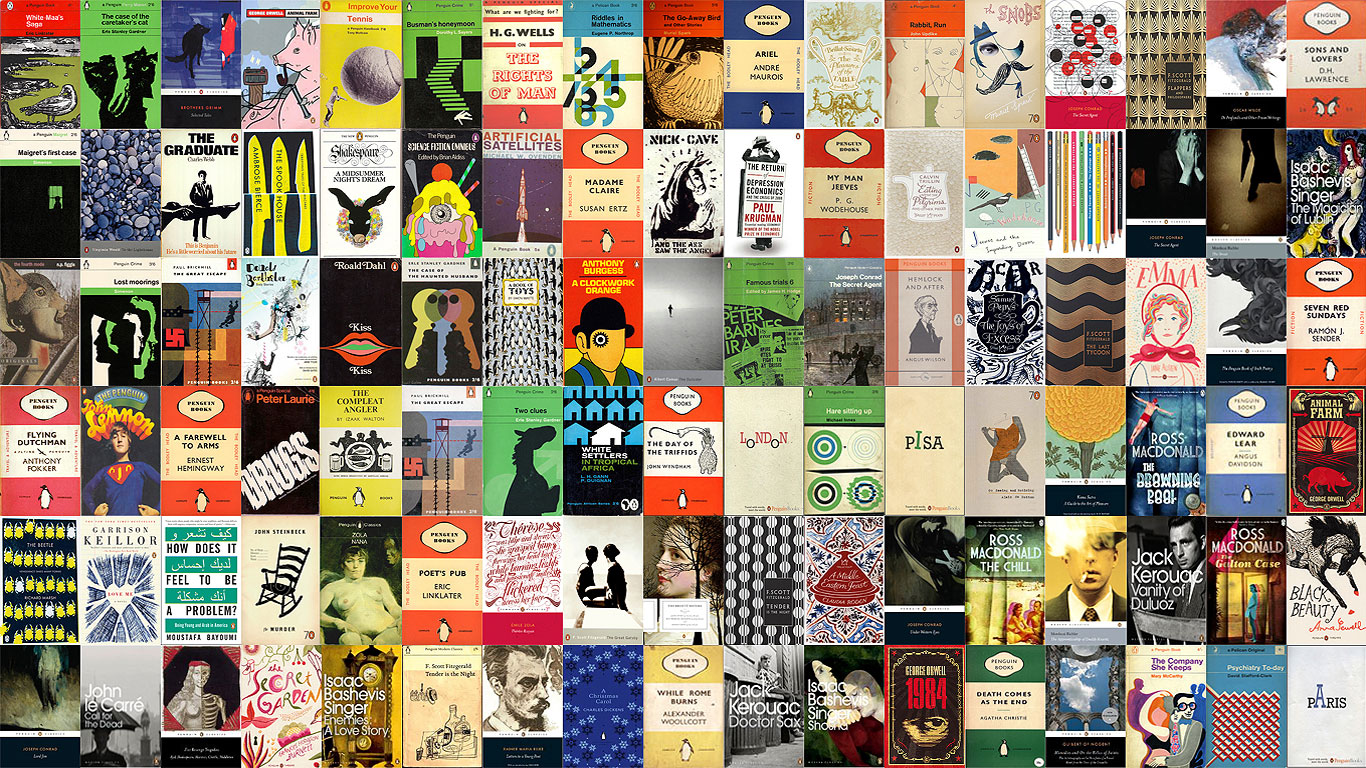
The illustrations in the book are mostly those of the various front cover titles, some of which showed the different coloured paperbacks of the early years. The colouring depended on the nature of the subjects – fiction, literature, science, etc.   The Penguin motif was presented with the bird in different postures and other birds, such as the pelican and the puffin, were added to special subjects. The books were an absorbing source of interest and included all the great fiction writers of the mid-century including Maugham, Forester, Waugh, H. G. Wells, Thomas Mann, Virginia Woolf, and the works of Bernard Shaw and other literary authors. Many of the older classics included such favourites of mine as The Meditations of Marcus Aurelius, an Essay on The Principle of Population by Malthus and the Rights of Man by Thomas Paine.

The editors are certainly justified in saying that the Penguin paperbacks have played an important and evolving part in Britain’s culture and design history.  It claims the distinction of providing inspiring images in its cover designs and rightly states in its first introduction “Filled with inspiring images, Penguin by Design demonstrates just how difficult it is not to judge a book by its cover”.

Sunday, 25 October 2015

Wake up, smell the flowers, they might not be around for long.


The Irish Times, Sustainability and the future of Mankind

The Irish Times, in an editorial on the 1/4/2014, called for action on climate change.  This is not the first time the newspaper alluded to this subject nor were the views of its correspondents and contributors over years any different.  However, the newspaper fails to allude to or advise about the real solutions to environmental and population problems.  It underlines the threat but it provides no practical means of a solution.  The editorial was critical of our government for its lack of action in dealing with matters which were a threat to the environment and to the future of humanity but our government is no different from the shortcomings of other world governments.

The Irish Times at least has the distinction that it shows concern for the future of the planet and humanity unlike our other leading newspapers who show little interest or sense of balance in the subject. The same may be said about the leading British papers. No papers, British or Irish, including the Irish Times, give any attention to human population which has increased threefold during the last 70 years, a trend which shows no slowing or stopping. Currently, according to the WHO and other sources  the number of births among humans exceeds deaths by 80 million annually. Added to the excessive birth rate we have the remarkable and progressive increase in human longevity over the past hundred years. There is no any evidence that this increase shows any tendency to slow or reverse. Since 1980 to 2012, over a period of 32 years in the UK, male longevity has increased from 71 to 79.5 years and female longevity has increased from 77 to 83.2. This is confirmed by a WHO report. The Irish figures are similar to those of the British. Increasing longevity exists worldwide and adds to the effects of the excesss of births over death.

Sustainability is the magic word of the politicians and most environmentalists who claim to be concerned about the ecology and the threat to Nature.  Sustainability I presume refers to the earth’s natural resources which maintain the health and wellbeing of nature in its widest sense but sustainability has its limitations and the politicians have little insight into the real threat facing humanity and our living world.  I quote from the Worldwatch Institute in 2013 about this magic word, sustainability, used by the politicians which has

“…lost its meaning and impact.  Worse, its frequent and inappropriate use lulls us into the dreamy belief that all of us – everything we do, everything we buy, everything we use – are able to go on forever, world without end, amen.”

The failure to achieve any worthwhile progress in protecting Nature and humanity during the many government summits during the last 30 years or more is too obvious and no doubt the same results will prevail following the next United Nations meeting fixed for France next year.  And those of us who have been trained in epidemiology, in the study of human and natural trends in the world, must know that the continued expansion in the human population and its rapid depletion of nature’s resources are leading to a disaster which is proceeding more rapidly than we realise.  Our politicians and many of our organisations devoted to the environment and to the welfare of humanity fail to provide solutions which might save us from disaster.  Nor does the public seem overly concerned.  The solutions occasionally put forward for change are far removed from the fundamental problems which are at the basis of the immediate threat to Nature and humanity, and these problems need to be dealt with radically and promptly if we are to survive the current crisis.

There should be a prohibition of unnecessary travel by private car, plane and rail as long as they depend on fossil fuels.  Energy in the form of domestic and public heating must be curbed by means of clothing or other forms of protection and energy must be sought from renewable sources only and for this we need sun, wind and water.  Progress in these areas will not be easy but it is not beyond our ability to achieve solutions if our commitment is strong.  We already have wind and water power and some solar power in the use of fridges, lights, phones and heating devices.

We must revert to community living and we must provide our food as much as possible from our immediate surroundings.  The vegetable and fruit allotments will be as essential to us as the very houses we live in.  Household gardens which are currently non-productive can be sources of food production. So can wasteland. Rainwater can be used and utilised to a much greater extent as a response to our current water extravagance.  Surely every house in the country should have a butt to collect rainwater.   Big reductions in water can be achieved by good husbandry in the home and the office and by commercial organisations.  The water tax should be imposed and should be applied to all except under very unusual circumstances.

people per km2
We need to reverse the current trend of adding more to the population of our cities and towns, and reverting to community life and living in the countryside. This trend may be unavoidable because of the increasing rise of the ocean and the flooding of our coastal cities and towns.  Goods and luxuries which are widely manufactured by commercial companies and which deplete our energy sources are not necessary for our daily needs.  They should be curbed.  We also dispose of huge amounts of food in the more prosperous parts of the world, and such waste should be fully conserved for domestic and other animals.

There is failure to understand, recognise and prevent the rapid loss of plant and animal species. We have lost the elm and soon the ash will be gone unless by some miracle it is saved – a disaster to our countryside and our country. And other trees are threatened too. Minister of State Tom Hayes, in his contribution to the All Ireland meeting of politicians and silviculturists last May, had this to say

While chalara (the cause of the ash dieback) is the subject of to-day’s conference, it is taking place at a time when it seems that Ireland’s forests are under attack from a number of different sources, both biotic and abiotic. The increase in the number of new findings of phytophthora ramorum is a serious concern. Since 2012 the number of infected larch sites has increased from 16 to 30. P ramorum is an aggressive disease and is causing significant damage to Japanese larch and is also infecting Noble fir, beech and Spanish chestnut at a number of infected larch areas.

Added to this we must add the rapid loss of land and ocean ice. The ocean’s rise in level, temperature and acidity, the drying up of lakes and rivers and the rapid and critical rise in atmospheric CO2 are already upon us. CO2 in the earth’s atmosphere is a greenhouse gas and its accumulation leads to earth warming.  It has remained at the same level, under 300mgs per cent, for millions of years but recently, since 1955, when it was measured at about 330mgs, it has now reached 400mgs and it is clear that this rise continues exponentially – which presages the further gathering rise in greenhouse gases and therefore in the earth’s temperature.  The accumulation of CO2 has been largely caused by the burning of fossil fuels.  It is generally agreed by scientists that this rise can be a serious threat to the earth and its inhabitants and that at best it needs to be kept at or below a level of about 400 parts per million. 

Above all, there are too many people in the world, with a population still advancing in numbers.  Even in the most healthy and natural environment the good God gave us, it is unlikely we can survive with such numbers of humans, now about 7.2 billion.  The population in 1940 was estimated at 2.5 billion and the recent trebling is estimated to increase further at a rate of 80 million every year.  We will be close to 8 billion humans on the earth by the year 2022 or 2023.  There is no doubt that we as a species are in complete denial about our future.  Our lack of insight into our current circumstances are beyond understanding and the threat to our future should be obvious to our collective intelligence.

We might understand that those who believe in God and a better world hereafter might be less concerned about our future here on earth but the Godless at least should be cognisant of our criminal neglect of Nature and the future of our children and the natural world on which we depend for our existence. The only feasible way we can avoid Nemesis is to return to a strict community life where we avoid unnecessary luxuries and where we can, as far as it’s possible, depend solely on our own needs and without the need for continuous fossil fuel loss. Perhaps we also need keep our distance from the flora and fauna of distant and foreign lands.

We might of course find some comfort and consolation in humanity’s ability to face necessary problems with great ingenuity through the internet, particularly in terms of communication and travel reduction.  The internet might well provide the means of humanity living tolerable and even better lives.  Homo sapiens has an unlimited ability and ingenuity to respond if the need is great.  We might survive at a community level through such changes as the abolition of the private motorcar and flying, and by electronic forms of communication.  By adopting community living we can provide all capable households with allotments to grow much of their own vegetables and fruit as a routine part of domesticity and we can adopt a public policy aimed at reversing the growth of cities and towns.  There is more land in most countries for many small habitations and allotments and still leave enough land for essential crops and for forests and hedgerow trees.

John Milton, in his Paradise Lost, quotes the Angel Gabriel who said to Adam “Do not try to understand the stars”.  Was this a warning that we might destroy ourselves by our domination of the world and of Nature?  Will the excessive and expanding human population, based on humanity’s success in controlling its own destiny through medical and scientific progress and the despoiling of our natural resources, be at the basis of international political failure leading to catastrophic nuclear war?

Every international environmental and climate summit meeting during the last three decades or more has failed because politicians and international governments have been dominated and kept in power by selfish and commercially dominated interests and an indifferent and ever-demanding public.  No significant action has ever been taken by such international meetings commensurate with our knowledge of the certainty of catastrophic environmental change.  Their mantra is sustainability but this is an empty formula.  Are there still ways humanity might adapt to alter current behaviour?  We cannot sustain the planets future health if we do not maintain its limited resources.  This is the simple fact of our dilemma.

The ultimate objective of a rational society should be to live in harmony with Nature.  The great Russian physiologist Ivan Pavlov defined health as a state of being in equilibrium with Nature.  Certainly the health of future generations is dependent on harmony with Nature which should compel current generations to avoid Nemesis by ensuring that we care for our natural surroundings as assiduously as we care for ourselves.  Humanity’s current obsession with material acquisitions, its gross neglect of our natural surroundings on which we depend on our welfare and survival, its waste of Nature’s limited resources added, about all, to its burgeoning human population, does not bode well for our immediate future, unless we are guided and lead by our world leaders.  And who is there to lead us?

Could the next international meeting of our leaders be an opportunity for Ireland to lead the world in protecting the planet and the future of our children and children’s children by presenting the bald facts about the population explosion and the CO2 climb and its causes?

Risteárd Mulcahy, MD.

Words: 2,030 (17/7/2014)


Addendum (6.1.2015)

On January 6th 2015 a lengthy editorial ‘’An Emerging Consensus’’ appeared in the Irish Times . It is a welcome addition to the subject of climate change and the future threat to Nature and to mankind but it is still just a masterly expression of sustainability and provides no hope of a practical answer to the threat to the world as we know it. The editorial’s lack of realism can be summed up by its penultimate paragraph. When speaking of Ireland’s role as envisaged by our Minister for Energy, Alex White, the minister is quoting as saying

It was playing an active part in meeting collective EU targets and global aspirations, for reduced carbon emissions through energy efficiency, renewable energy, re-forestation, improved agricultural practices and financial support for developing countries.

I must have some doubts about the extent of the minister’s aspirations but my real concern is that the editor fails to comment on the annual 80 million increase in population in the world. We are already aware of the trebling of the human population during the last 70 years and the effects this is having on population pressures in many parts of the world, not to mention the gradual and extensive loss of flora and fauna, the destruction of which may lead to a planet uninhabitable for all living things.

Saturday, 17 October 2015

Irish High Crosses


Irish High Crosses - with the figure sculptures explained. Author, Peter Harbison and published by the Boyle Valley Honey Company. 

This review was written on October 15th 2015

This attractive and informative little book written by Peter Harbison and illustrated by Hilary Gilmore was presented to me by the author at an exhibition of six of our great High Crosses which were on display at the Collins Museum about three years ago.  The book was published by the Boyne Valley Honey Company first in 1994 and mine was a second edition published in 2001 with an introduction by Lord Killanin.  

It is a short book of 110 pages but deals with the 75 Irish High Crosses scattered throughout the four corners of Ireland with their sculptured features presented and explained in considerable detail.  There are about the same number of non-decorated stones of historical or ancient significance but which lack the details of the stones I am dealing with in this essay. They number too about 75 and are scattered equally around the country.  These are listed but are not dealt in detail within this essay.

Most of the sculptured stones have been provided with photographs or designs. Some display considerable detail despite their age and their exposure to the elements during the centuries.   Added to the crosses there is a wealth of detail, some reminding us of biblical and religious artefacts.  We have details about the location of these stones and their condition over their many years of existence. The stones were almost entirely placed in monasteries or graveyards and are reminders of the Christian faith and the bible which were such a feature of Ireland and Gaelic culture during the middle ages. All were constructed between the 7th and the 12th centuries.   There are some historical details in the book about their years of construction and even about a few of the artists and workers involved.

In the introduction we find:

"High crosses are among the most important monuments to survive from Ireland’s golden age of Saints and Scholars, and the sculptured ones are described in detail here.  Their figure carvings illustrate the Bible story like a filmstrip and this guide explains what the individual panels represent.  Many novel identifications offered by the author shed new light on the deeper religious meanings of the crosses which can vary according to the choice of Biblical subjects.  The book is designed as a field guide for those who want to study the crosses at first hand. Black and white diagrams assist in pinpointing the various Old and New Testament scenes sculpted on them"

At Moone, Co. Kildare.
These memorials are cared for by the Board of Works, by the local authorities and by the local people who have the stones on their property. Some are now protected indoors in chapels or museums and are replaced by concrete replicas on the site. As regards the survival of these treasures, it is fortunate that many of the crosses are lying in less visited parts of the country and in old, remote graveyards or long since deserted churches.  They were erected when Ireland spawned its great reputation of Christianity. In this guide they are arranged in alphabetical order of their titles and sites, and the National Grid reference will help the reader to locate them at the end of the booklet.

Two crosses at Ahenny
Ireland can boast an early and rich history of fifteen centuries which must be unique in Europe in terms of a settled language, tradition and culture.   Many of these stones have survived in the countryside without obvious damage but naturally there are many pieces affected by the passage of time, the attention of the local and travelling people, the inevitable ageing of the material such as sandstone used by some of the artists and the national attention in the past century or two to attend to their preservation. Whilst many of the relics are found in the more remote areas of our countryside, others are well known and are more easily accessed by the visitor. Recently we visited the two crosses at Ahenny in the southeastern part of Co Tipperary. It took us quite some time to find them and then only with the assistance of some of the local people.  The two crosses remain undisturbed and a natural feature of the old cemetery, made all the more so by the finding of recent as well as long standing burials.

On the banks of the Shannon in Co. Offaly in the centre of Ireland, the details of the artefacts at Clonmacnoise are described in eight pages.  The crosses have now been moved for safety to an indoor location on the site. The site on the Shannon is physically in the centre of Ireland and was founded in the year 545 by St. Ciaran. It has a history of about 15 hundred years since its foundation. According to local history the monastery “chose its abbots for their qualities rather for their family connections”.

It has amongst other relics a round tower erected about the 11th or 12th century and evidence of six churches providing a site of great pilgrimage for centuries.  Other artefacts are also on display in the new interpretive centre.  There are many details of the three great crosses on the site and much information is provided which subsequently is mentioned by the Annals of the Four Masters when they were alluding to the affairs of the monastery during the 10th and 11th centuries.  The largest of the five crosses is called The Cross of the Scriptures and is described in detail with the sculpture base having the four different faces North, South, East and West.

The details retained on the cross at Kills in Co Meath are still quite extraordinary where again the four sides of the cross are described in great detail and are still in a remarkable degree of preservation.  They are certainly worthy of a visit, particularly if one is equipped with the information at hand in this or other equally informed documents. The designs of the crosses and the other structures, and the closeness of Killary and Slane, with their own artefacts, are within 30 miles of Dublin, as are Monasterboice, Glendelough, Templemore and other sites. They can be easily reached from the city. Indeed, with our recently acquired motorways built from Dublin in all directions of the island, a week’s holiday spent visiting our monastic sites included in this book could be provided with a wealth of biblical and historical detail and with the deep sense of knowledge provided by the author. 

Adam and Eve at Kells
Some of the other more distant sites are of equal interest.  Cashel, about 100 miles from Dublin, is worth a visit for it’s ancient church, cross and great tower.  On the way home, one can visit Castledermot for its cross and its other ancient artefacts.  Within the four corners of Ireland there are more than enough sites worth a visit by the stranger which will provide a fine opportunity to see some of the more remarkable reminders of our ancient past and of our ancient culture and between visits there is always an opportunity in finding a pub or hostelry where one might enjoy some of the other pleasures of a visit to Ireland.